











Can The LONCIN XWOLF1000 Mud CVT Survive in Deep Mud?
For ATVs, the real test in deep mud environments often lies not in the powertrain, but in the transmission system. When a vehicle is under high load and low speed for extended periods, the CVT system needs to continuously withstand heat buildup, torque surges, and the additional stress from mud and water intrusion. Failure in any of these areas can directly impact power transmission efficiency and even shorten the lifespan of critical components.
Can an ATV truly survive continuous deep mud torture? The LONCIN XWOLF1000 Mud’s answer isn’t just a slogan, but a comprehensive engineering solution designed around CVT durability.
How Does the LONCIN XWOLF1000 Mud Protect The CVT from An Engineering Perspective?
In deep mud conditions, CVT reliability primarily depends on intake air cleanliness, thermal control capabilities, and load release stability.
The XWOLF1000 Mud’s design logic is not about single-point reinforcement, but rather about reducing the probability of failure at the system level.
High-position Air Intake Path Design
The XWOLF1000 Mud repositions the CVT air intake to a higher position and adjusts the air intake direction to keep it away from the area affected by tire mud splashes.
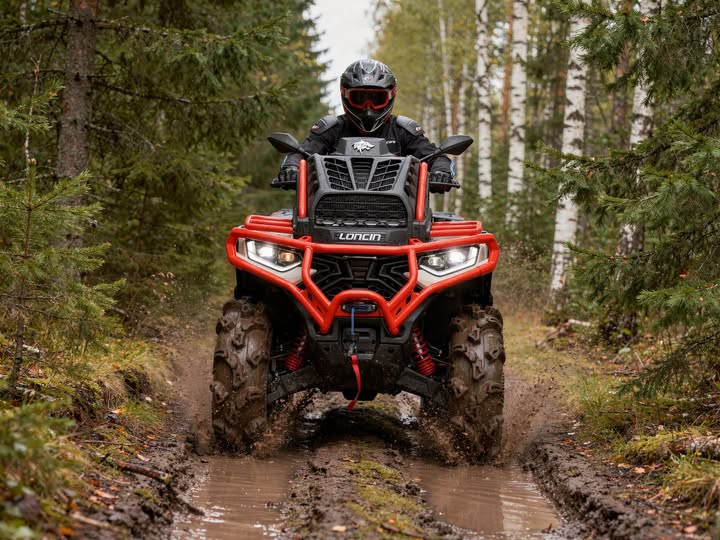
The air intake height is approximately 420–450mm (varying with suspension travel). This reduces the probability of mud and particles directly entering the CVT, lowering the risk of contamination at the source.
Enhanced Sealing Architecture
The CVT housing employs a multi-layer sealing design instead of a single gasket structure.
Key features include:
- Multi-segment sealing compression structure
- Optimized joint leak-proof path
- Reinforced housing locking structure
In testing, it can withstand equivalent hydrostatic pressure at a water depth of approximately 0.8–1.0 m (30-minute cycle test).
This enhances sealing stability in deep mud and wading environments.
Thermal Management Optimization System
The air duct system has been redesigned to create a stable circulation path for incoming cold air.
Airflow is as follows: Intake → Guide → Heat Exchange → Exhaust
During continuous deep mud load testing, the CVT operating temperature was maintained within the range of approximately 85–115°C, preventing it from entering the high-temperature failure zone.
This also reduces the rate of heat accumulation and minimizes heat loss from the conveyor belt.
Clutch Calibration for Muddy Conditions
CVT calibration has been optimized for low-speed, high-load conditions.
Key benefits include:
- More linear clutch engagement process
- Less transient belt slippage
- More stable torque output
The goal is to reduce belt impact load when extricating from deep mud.
Quick Maintenance Design
The CVT structure optimizes maintenance access paths for rapid condition checks.
It allows for:
- Conveyor belt condition checks
- Mud residue confirmation
- Pulley wear assessment
Standard quick check time is approximately 10–15 minutes. This improves the efficiency and frequency of maintenance after use in deep mud.
Basic Post-Use Maintenance Recommendations
Even with optimized CVT design, deep mud environments can still introduce mud, heat load, and wear residue, making basic post-use checks essential.
After each deep mud ride, it is recommended to:
- Clean the CVT ventilation channels to ensure unobstructed airflow.
- Check for any unusually high-temperature odor (indicating overheating).
- Remove any mud residue from the housing and air intake area.
- Check the conveyor belt surface for slippage or shine.
Under high-intensity use, a complete CVT disassembly and inspection (conveyor belt/clutch/pulley condition check) is recommended every 25–50 hours of heavy mud driving.
The purpose of this process is not to fix problems, but to maintain stable CVT operation in high-load muddy environments.
Conclusion
From a design perspective, the LONCIN XWOLF1000 Mud’s focus is not on maximizing extreme performance, but rather on extending the CVT’s stable operating window in deep mud conditions. It doesn’t change the inherent load on the mechanical system in deep mud, but it implements targeted controls at key failure points.
This makes it more of a “continuously stable” mud-terrain ATV than a machine designed for short-term extreme traversal.
See how the XWOLF1000 Mud performs in real-world mud environments.
.webp "XWolf700L 9")
.webp "XWolf550L 10")
.webp "XWolf300 11")
.jpg "XWolf200 12")
-1.webp "UWolf1000 13")
.webp "UWolf700L 14")